How Can I Let My Client Review the Application Trademark
The letter comes in the mail service from OED asking you a few questions about a handful of trademark applications, including whether each form was electronically signed by the respective applicant or attorney. The calorie-free bulb still has non hitting—you ask yourself who is OED, and why are they asking about signatures. Yous read further into the letter of the alphabet, known as a Request for Data and Evidence (RFI) and you see allegations of competence, misconduct, and citations to the TMEP. This must be a joke!
Past the time you get further into reading TMEP, you lot realize that the rules country that "a signature must bear either a handwritten signature personally signed in permanent ink by the person named as the signatory, or an 'electronic signature' that meets the requirements of 37 C.F.R. § 2.193(c), personally entered past the signatory." See TMEP 611.01(b). You lot and then read farther into the regulation and note that Department 2.193(c) dictates that "A person signing a document electronically must … Personally enter any combination of messages, numbers, spaces and/or punctuation marks that he or she has adopted equally a signature, placed between two forward slash ("/") symbols in the signature block on the electronic submission…" Of course, the TMEP Section 611.01(c) provides further explanation.
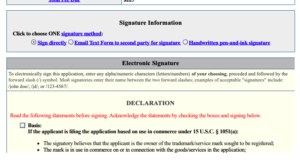
Equally you lot read the RFI, you are still puzzled because you lot believe all the trademark applications and responses you lot filed were done correctly. In fact, you personally reviewed each awarding or other document before information technology was filed. The next morn, as you are approving another prepare of trademark filings, yous realize that you did not sign the mark—it was pre-signed. Then it hits you—OED believes that lawyers are non permitted to sign documents on behalf of clients, and cannot have their ain paralegals "sign" the attorney's name.
You do your diligent research and find that the Electronic Signature in Global and National Commerce Act, 15 U.Due south.C. § 7001 clearly preempts most other laws governing signatures, and that contracts cannot be invalidated solely due to the mechanism of the signature. You further look at the Restatement of the Police, Agency and seem to observe authority supporting the position that your conduct was in fact appropriate—but it is non clear.
You think the worst and read well-nigh OED Terminal Orders in which attorneys lost their license for similar declared behave. Hopefully, you as well understand the importance of responding promptly and honestly to OED, with an advisable legal strategy. Of course, as yous make up one's mind to respond, you think about the importance of: (1) protecting your clients' rights; (2) protecting your police force license; and (3) correcting whatever bug.
But how did yous get into OED'due south sights? The respond is likely related to IP addresses, statistics, and trademark examining attorneys. Suspicious activity, including strange IP addresses or numerous successive filings, peculiarly those rife with mistakes, can cause referrals to OED for farther investigation. Therefore, information technology is important for trademark practitioners to exist mindful of their obligations under the TMEP—including the often-unknown signature rules, and ensure that the named signatory personally signs their own names—and that they are the proper person to sign. Some of import tips:
- The client should sign trademark filings whenever possible. This can be achieved using the ESIGN-ON method, and allows the client to brand the declaration, rather than the attorney. While this method may consume more time, information technology offers protection under multiple provisions (e., 37 C.F.R. § 11.18) since the client is making the proclamation.
- The attorney should personally (not through a paralegal) sign documents when the client is unable, or the rules otherwise crave such, only only after careful review of the facts. In such a example, it may be necessary for the attorney to independently review facts, or ask the customer further questions.
- The client should e'er sign the power of chaser, unless another attorney from the same house is already of tape.
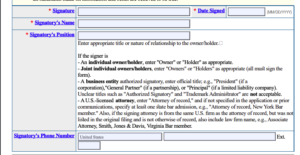
Whether or not you lot agree with OED's position regarding signature issues, the USPTO Director has approved the settlements of a number of trademark practitioners for similar behave. Indeed, many practitioners unfamiliar with the nuances of signature rules and OED practice accept fallen into the trap of easy settlement, leading to potential reciprocal subject area. Practitioners should be mindful of the importance of working to protect the rights of clients, and avoiding the ire of OED. Afterwards all, the signing of a signature past the "correct" party demand merely add a few minutes to each awarding.
Of course, if you find yourself already in a predicament of an OED investigation, as noted in a higher place, it is important to take furtive steps. Some to consider include:
- Addressing the underlying problem through procedural changes and/or acknowledgement
- Explaining how you have or volition inform client
- Making appropriate disclosures to the tribunal, if applicative
- Taking other actions to protect client rights
Afterall, with a mission to protect clients and the public, many practitioners who take inadvertently violated 37 C.F.R. § 2.193 (or 37 C.F.R. § 1.4) have had success in working diligently to respond and accept corrective action. Those who did not appear to work diligently often appear to have lost their license.
Source: https://ipethicslaw.com/11250-2/
0 Response to "How Can I Let My Client Review the Application Trademark"
Post a Comment